To assist with changing internalized patterns, we can benefit from an understanding of how the brain functions.
Here is an example of a neuroscience model which details three separate functions.
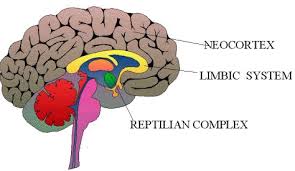
REPTILIAN BRAIN: The Survival Brain
The Reptilian Brain is concerned with survival and life sustaining requirements such as food, sex and sleep. The Reptilian Brain engages the environment by assessing external threat. It responds to threats or perceived threats with three simple processes.
- attack / domination patterns i.e. fight,
- withdrawal / submissive patterns i.e flight,
- or lock down / stuck patterns i.e. freeze.
Anxiety, addictions, aggression and depression are functions of this level of our neurology.
Instinctual responses and reaction patterns of the Reptilian Brain can be updated during the session work to create more appropriate and useful outcomes. Anxiety, addictions, aggression, depression and phobias can be shifted and released.
LIMBIC/MAMMALIAN BRAIN: The Emotional Brain
The Limbic / Mammalian Brain functions as a processor of memory and emotion.
It organizes a library of memories combining both the sensory impressions and emotional responses arising from any experience. It stores that information in both a neuronal network in the brain as well as polarized electro-magnetic field that extends out into the space surrounding the body. In many ways this part of your brain is constantly writing a living record of your life. Negative experiences and traumatic memories stored in the Limbic Brain seek resolution or completion. They demand your attention and disrupt healthy growth and adaptation to life until they are resolved and neutralized.
During a session you are taught how to effectively work with memories that hold a negative charge. New energy floods in and you learn how to move through and beyond what seemed like insurmountable problems.
NEO-CORTEX BRAIN: The Thinking Brain
The Neo-Cortex is capable of processing verbal and metaphorical language allowing us to extract a sense of ‘meaning’ from any situation. When experiences are difficult, threatening or emotionally overwhelming the ability of the Neo-Cortex to encode meaning becomes disrupted. This neurological disruption tends to manifest behaviourally as repetitive patterns and cycles of negativity in your life that you cannot seem to move beyond.
During a session the disruptions are repaired. Changes can be made that open up greater freedom of expression. An increased ability is gained to respond to circumstances in new ways beyond the old patterns and conditioned habits.
 INTEGRITY THERAPEUTICS